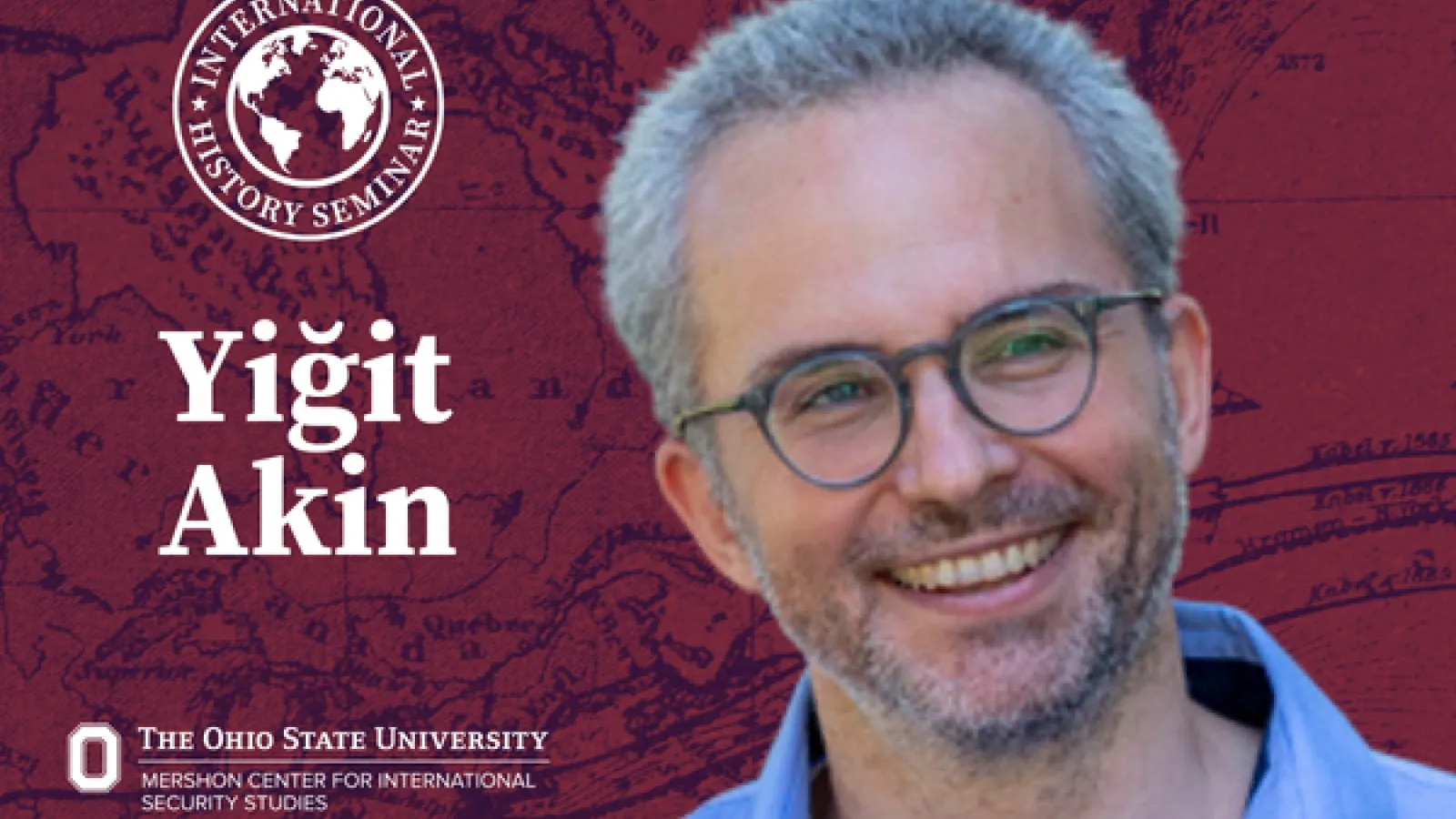
Coffee will be served at 3:30pm. The event will start at 4:00pm.
Title
The Ottomans in a Revolutionary World, 1917-1923
Abstract
The twilight years of the Ottoman Empire between 1917 and 1923 constituted a period of extraordinary political and intellectual ferment. Unlike the other major land empires, Germany, Austria-Hungary, and Russia, the Ottoman Empire had not formally collapsed by the end of the Great War. Yet the empire’s future hung precariously in the balance. The gravity of the moment sparked intense debates across the empire’s ethno-religious communities about the meaning of defeat and the possible trajectories ahead. Ottoman intellectuals and political actors grappled with the prospects for renewed co-existence in the aftermath of massive wartime violence against Ottoman non-Muslims, while also debating the empire’s place within an emerging postwar global order.
Those who engaged in these debates were acutely aware that they were living through an exceptional historical conjuncture. As official Ottoman diplomacy sought to navigate the hostile terrain of postwar international politics and secure integration into the emerging liberal-imperial order, public discourse flourished around competing visions of sovereignty, legitimacy, and international belonging. When these diplomatic efforts proved futile and the peacemakers imposed the punitive Treaty of Sèvres in August 1920, many Ottomans began to explore alternative global imaginaries.
Increasingly, they situated their struggle within a broader transnational movement against imperial domination and racial hierarchy, drawing connections between their own predicament and those of Indians, Egyptians, Africans, and the Irish. Public opinion revealed a growing fascination with the Soviet experiment, not only with the new life the Bolsheviks were establishing at home, but also with their advocacy of a radically reconfigured, non-hierarchical international order. Others, however, remained committed to engagement with the Versailles system, viewing it as the most viable framework for preserving the empire’s sovereignty within a deeply stratified global structure.
In the Great War’s aftermath, Ottomans thus engaged intensely with global political currents, debated competing visions of international order, and reimagined their collective future within broader transnational configurations. This paper examines what may be understood as the most “internationalist moment” in the empire’s long history, discussing how Ottoman actors interpreted, appropriated, and contested the revolutionary transformations reshaping the world between 1917 and 1923.
Speaker
Yiğit Akın earned his Ph.D. at the Ohio State University in 2011 and he is a specialist of the history of the modern Middle East. His research interests include social and cultural history of the late Ottoman Empire and early Republican Turkey, with a particular focus on the First World War and its aftermath, war and society, nationalism, and social movements. Before joining the faculty at Ohio State, Dr. Akın taught at the College of Charleston and Tulane University where he received the university’s highest teaching award, the Weiss Presidential Award for Undergraduate Teaching.
Dr. Akın is the author of two books. The first, Gürbüz ve Yavuz Evlatlar: Erken Cumhuriyet’te Beden Terbiyesi ve Spor (‘Robust and Vigorous Children’: Physical Education and Sports in Early Republican Turkey) (İletişim, 2004), offers a new framework for thinking about the relationship between sports and physical education, governmentality, public health, and nationalism in early republican Turkey. It won the 2005 Distinguished Young Social Scientist Award from the Turkish Social Science Association.
His second book, When the War Came Home: The Ottomans' Great War and the Devastation of an Empire (Stanford, 2018), examines the social and cultural dimensions of Ottoman society’s catastrophic experience of the First World War and analyzes the impact of the war on the empire’s civilian population. When the War Came Home was named a 2018 Choice Award for Outstanding Academic Title and won the 2019 Tomlinson Book Prize for the best work of history in English on World War One, awarded by the World War One Historical Association. The Turkish translation of the book was published under the title of Cihan Harbi'nin Cephe Gerisi (İletişim, 2025).
Dr. Akın is currently working on two book projects on the post-World War I years in the Ottoman Empire from a global perspective and the social and cultural history of death in the late Ottoman Empire and Republican Turkey.
He also serves as the co-editor of the Ottoman Empire/Middle East section of 1914-1918-online: International Encyclopedia of the First World War.
About the International History Seminar
If you are interested in attending this semester’s events and joining the International History Seminar, please send an email confirming your interest to the Hayes Chair Graduate Research Associate, Ian Gammon, at hayeschairgra@osu.edu, and you will be included on the mailing list going forward. Materials will only be pre-circulated to people on the mailing list.