Federalism, Cultural Identity, and Insecurity in Nepal

Overview
Program Partner: International Alert
The Mershon Center for International Security Studies collaborated with International Alert Nepal on a two-year research initiative examining the impact of federalization on inclusion, governance, and peacebuilding in Nepal. Introduced through the Constitution of Nepal, the country’s federal system was envisioned as a pathway toward sustainable peace by addressing longstanding political and social exclusion and devolving power beyond the center.
This research served as a Peace Audit of Nepal’s progress in fulfilling those constitutional commitments. It explored the complex interplay between cultural identity, insecurity, and federalism, examining how these dynamics continue to shape identity-based tensions and political participation. The study also assessed whether federal reforms have opened new political spaces for historically marginalized communities or whether existing hierarchies and forms of elite influence continue to shape outcomes.
Designed as an adaptive action-research initiative, the project combined desk-based analysis with extensive fieldwork. In summer 2023, Associate Director Teri Murphy and researchers from International Alert Nepal conducted interviews and focus groups in western provinces and the Kathmandu Valley with government officials, academics, journalists, human rights advocates, NGO practitioners, and community leaders. These consultations helped shape a broader two-year research agenda carried out by a team of 14 Nepali researchers.
The project investigated how decentralization has altered local power dynamics and governance across Koshi Province, Madhesh Province, and Sudurpashchim Province. Particular attention was given to the experiences and perspectives of historically marginalized communities, including Kiranti, Madhesi, Tharu, and Dalit populations. Through provincial case studies, the research examined whether federalization has expanded meaningful participation and representation, while also identifying gaps between constitutional intent and implementation.
The findings from this initiative are presented in three policy reports that analyze Nepal’s evolving federal system from a peace and conflict perspective. Together, they assess how authority and resources are being redistributed across the country’s three tiers of government and offer evidence-based recommendations to strengthen federalism as a tool for inclusive governance and sustainable peace.
Project Reports
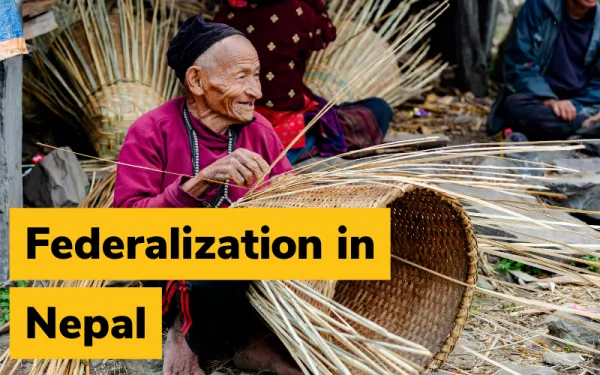
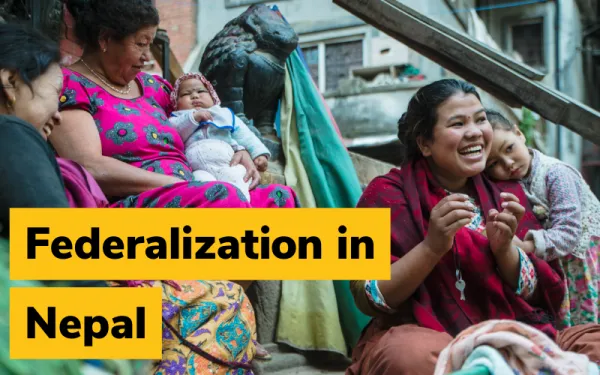
Federalization in Nepal: Post-Federal Power Devolution in Nepal: Case studies from Koshi, Madhesh, and Sudurpaschim Provinces (February 2026)
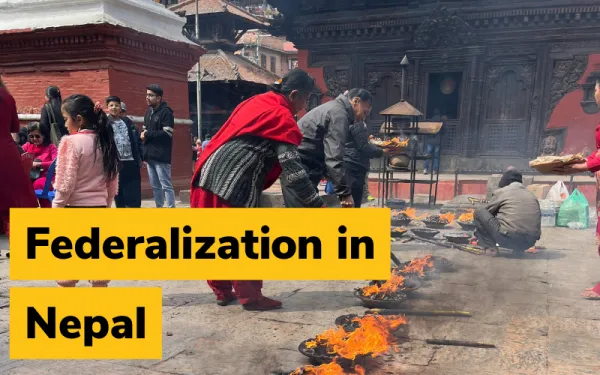
Federalization in Nepal: Inclusion with Limits: Assessing the Conflict Risks Arising from the Emerging Gaps in Nepal's Federalization Process (February 2026)
Federalization in Nepal: Post-Federal Power Devolution in Nepal: Case studies from Koshi, Madhesh, and Sudurpaschim Provinces (February 2026)
Federalization in Nepal: Inclusion with Limits: Assessing the Conflict Risks Arising from the Emerging Gaps in Nepal's Federalization Process (February 2026)