Register
Title
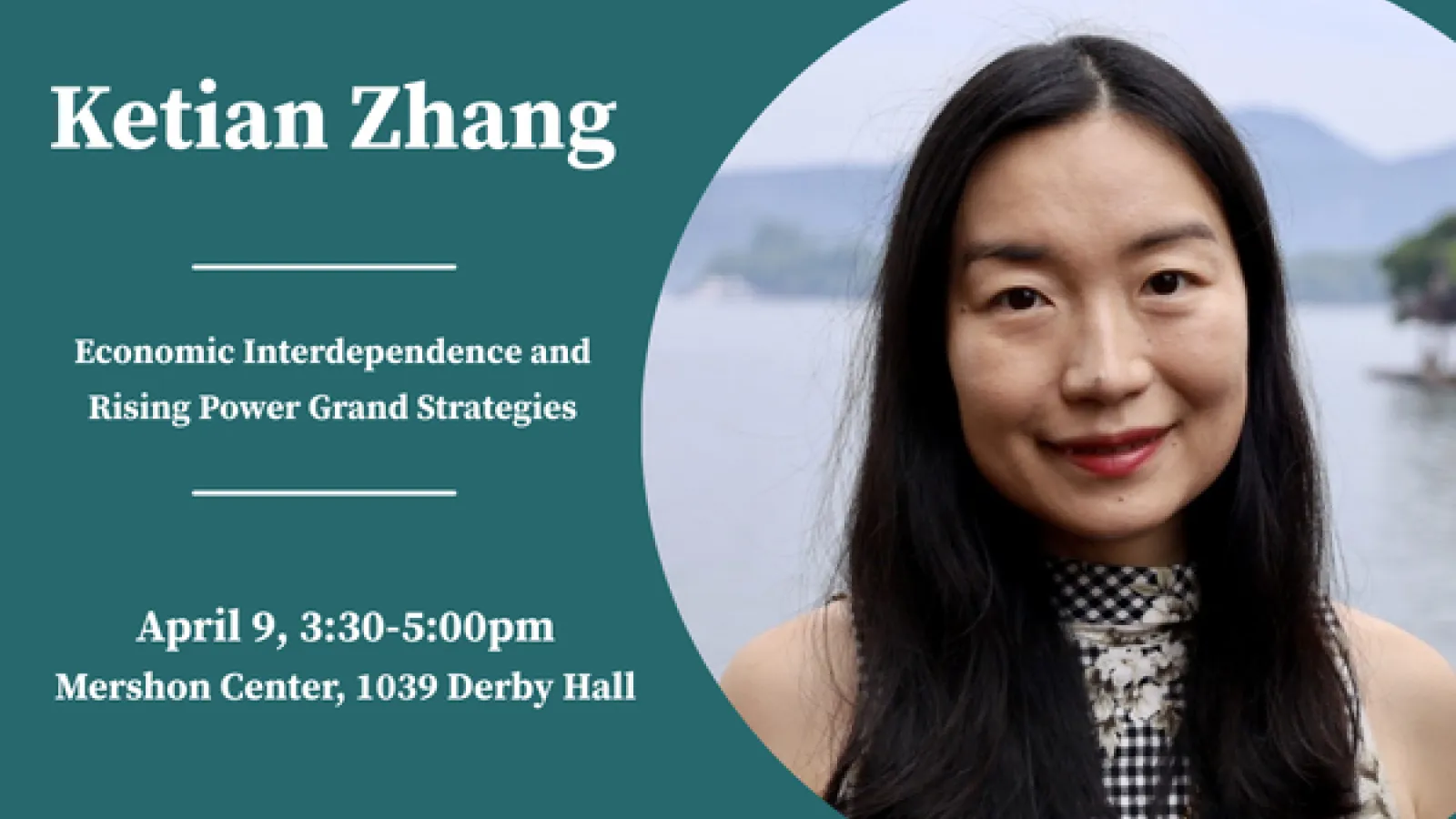
Economic Interdependence and Rising Power Grand Strategies by Ketian Zhang
Abstract
Compared to historical rising powers, China does not use force as often, prefers to utilize coercion instead of force, does not form formal alliances, and tends to resort to nonmilitarized tools, including economic statecraft. China exhibits a curious pattern of using nonmilitarized means to achieve its grand strategic ends. What explains China’s divergent path compared to historical rising powers such as the early American Republic and Germany under Bismarck? Do current global production and supply chains provide different incentives to contemporary rising powers’ use of military, economic, and diplomatic statecraft?
This book connects international security and international political economy while moving beyond the “commercial peace” argument to examine all facets of rising powers’ use of statecraft. Leveraging rich empirical evidence, including primary Chinese documents and interviews with Chinese and foreign officials, the book argues that different kinds of economic interdependence – historical and present – influence rising powers’ use of grand strategic means. Contemporary economic interdependence, characterized by global supply chains and intricate financial networks, both constrains and enables a rising China’s use of military, economic, and diplomatic statecraft. On the one hand, contemporary economic interdependence constrains China’s use of military force while moderating its use of positive and negative economic statecraft and shifting its diplomatic statecraft away from alliance politics to strategic partnerships. On the other hand, it offers China considerable leverage, enabling China to use non-militarized coercive tools, the Belt and Road Initiative, and extensive bilateral strategic partnerships for its grand strategic ends.
Speaker
Ketian Vivian Zhang is an Associate Professor of International Security in the Schar School of Policy and Government at George Mason University, where she also serves as the faculty director for the International Relations Policy Task Force. Her work focuses on rising powers, coercion, economic statecraft, and grand strategy, with a regional emphasis on China and East Asia. Ketian's research agenda explores how globalized production and supply chains affect rising power foreign policy, particularly in relation to coercion and strategic behavior. Her first book China’s Gambit, published by Cambridge University Press, examines when, why, and how China employs coercion in response to national security challenges, including territorial disputes in the South and East China Seas, foreign arms sales to Taiwan, and the reception of the Dalai Lama by foreign leaders. Her work has appeared in International Security, International Politics, Journal of Strategic Studies, Journal of Contemporary China, Texas National Security Review, among others. Ketian’s second book project investigates the relationship between economic interdependence and the grand strategies of rising powers. Ketian received her Ph.D. in Political Science from the Massachusetts Institute of Technology in 2018 and is an affiliate of the Security Studies Program. She has held fellowships at the Shorenstein Asia-Pacific Research Center (Stanford), the Belfer Center for Science and International Affairs (Harvard Kennedy School), and the Institute for Security and Conflict Studies (George Washington University).
Sponsors
The Institute for Chinese Studies
Mershon Center for International Security Studies