Agribusiness and Women’s Empowerment in Bangladesh
Fresh vegetables. Food processors. Specialized dairy startups. These businesses are all examples of the agripreneurship that is enhancing rural livelihoods and food security. Alexis Zickafoose, Ph.D. candidate in Agricultural Communication, Education, and Leadership, recently traveled to Bangladesh, with support from the Mershon Center, to better understand how owning and operating an agribusiness impacts women’s empowerment across individuals, institutions, and environments.
Bangladesh has adopted women’s empowerment and agripreneurship as priority areas for development. However, empowerment is routinely categorized as an outcome rather than a process. Zickafoose’s research examines how women’s agripreneurship supports the process of their empowerment through an institutional ethnography.
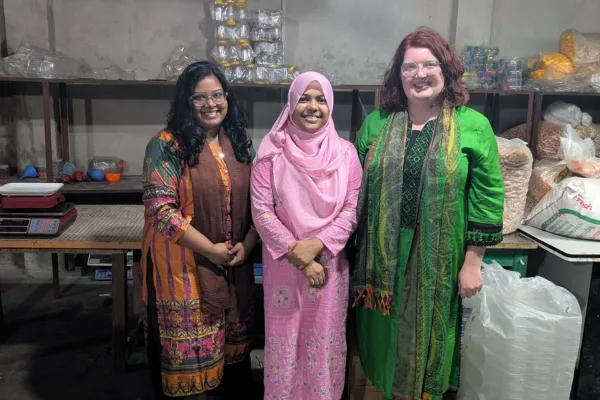
Through interviews in Dhaka, Rajshahi, and Comilla with women agripreneurs along the institutional value chain, she created an institutional map detailing the path of women agripreneurs. By partnering with the Bangladesh Small Cottage Industry Corporation, a department within the Bangladesh Ministry of Agriculture, this map will help spur policymaking discussions and program interventions that have potential to help not just the women in the study but women throughout the entire county.
“Meeting the women agripreneurs and hearing their stories has been one of the most interesting things about this project,” said Zickafoose. “I interviewed women from a variety of different backgrounds, and despite many external differences, they all have a common thread: grit. One woman, who I call Sufia, has been through such hardship but her dedication to her mother and living a good life is ineffable. All of the women I interviewed have been inspiring to me, and I feel honored to share their stories.”
Economic and food insecurity often lead to conflict, exacerbating persistent poverty. In international research, we tend to zoom out and examine trends, policies, and events with a birds-eye view. Zickafoose’s project looks at how national trends, policies, and events are impacting and shaping the women they are intended to support.
“My research increases understanding of human security by examining the process of social development of women in Bangladesh,” said Zickafoose. “Much empowerment research aims to quantify it without exploring the context within which women live, making us forget the human element. My research investigates the intersection of social and economic development through agripreneurship and empowerment. Because of the collaboration with an arm of the Bangladesh Ministry of Agriculture, the research results are poised to support a government in transition as they make decisions about the future of Bangladesh’s development.”
Ultimately, Zickafoose hopes that her research ignites broader discussions of gender-transformative development, agrarian political economy, and sustainability.
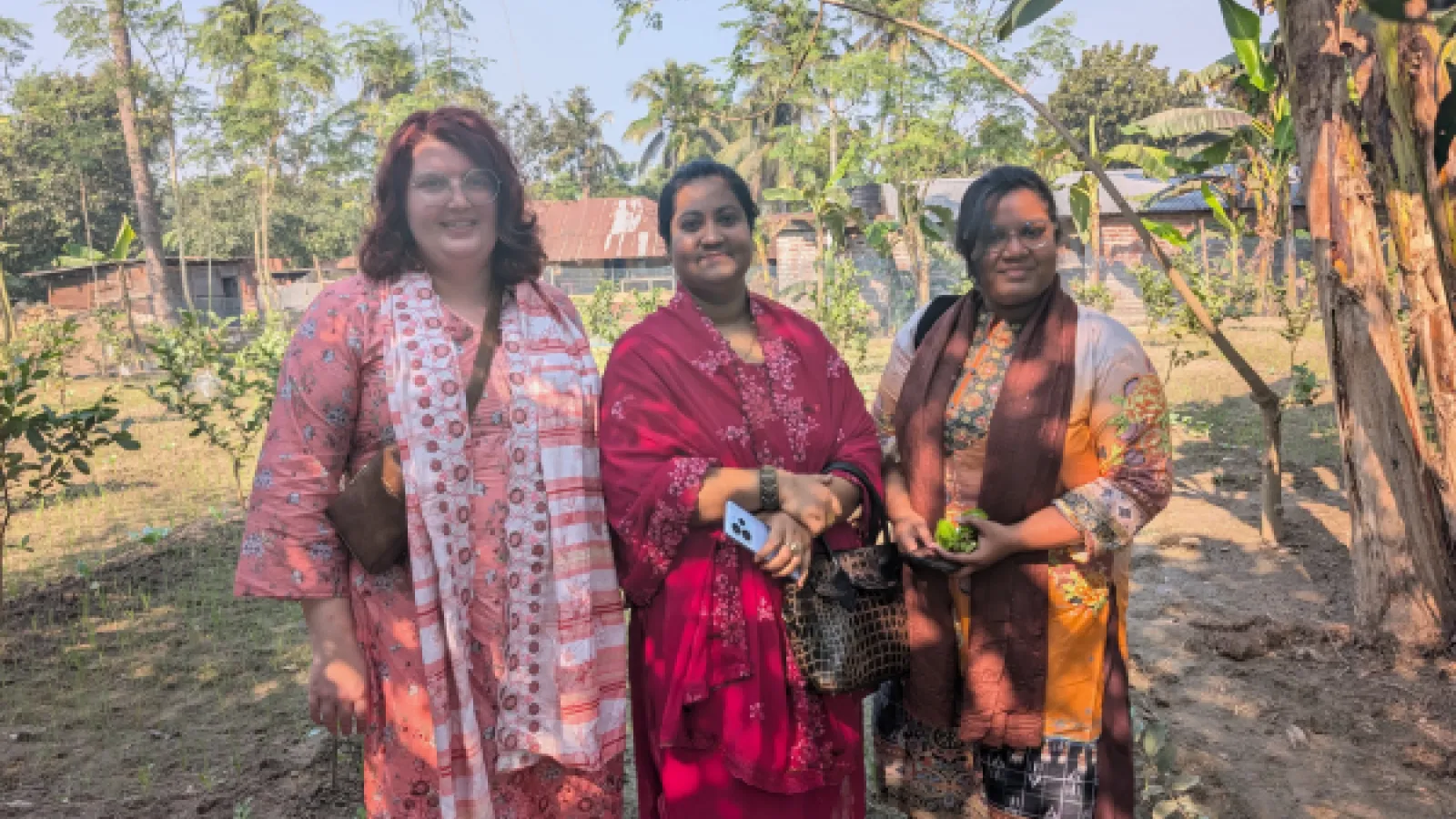
Top right photo caption: Alexis and Tuktuk, her interpreter, with Mahbuba, a farmer and wholesaler, at her farm in Rajshahi.