Mershon Mondays Feb 23: Devising 101
At our Mershon Monday on February 23, Kevin McClatchy, Associate Professor of Theatre, Film, and Media Arts and 2024-2025 Ohio State Artist Laureate, shared his experiences of incorporating theatre-inspired exercises to encourage students to inhabit the experiences of others in the classroom. Through several interactive activities drawn from his work as an actor and theater teacher, he encouraged participants to reflect on how these activities could advance their teaching goals, particularly when dealing with challenging subjects.
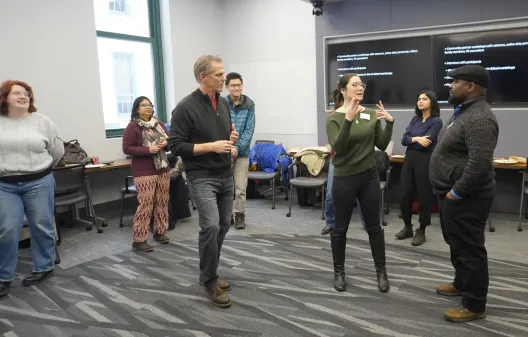
McClatchy, who has been a professional actor for decades, prompted the audience to reflect on how storytelling relates to diverse areas of research and teaching. Storytelling is a primary way of making sense of our experiences and those of others. Central to storytelling, he suggested, is the choice to find someone else fascinating. He added that acting is finding the areas of connection between oneself and the character. By bringing together storytelling and empathy-based tools, we can complement the narratives present in books, literature, and archives and ultimately, come to understand the human experience in an embodied way.
McClatchy introduced us to several of his projects that use acting as a tool to unlock empathy and connection. The Camouflage Project portrayed the lives of four women in occupied France working as wireless operators. Exercises like writing and reflecting on the characters’ inner thoughts encouraged the actors to consider how their character might express themselves – what in acting is called “scenic truth”. These techniques have also been central to McClatchy’s community outreach initiatives. In the Beyond All Recognition project, for example, McClatchy hosted workshops with Master of Fine Arts (MFA) students, counselors to veterans, military personnel veterans, and their family members, and used Shakespeare’s plays to give voice to emotions in novel ways.
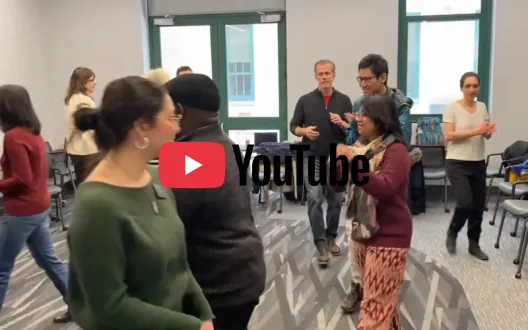
During the session, McClatchy encouraged the audience to begin by standing in a circle and tapping a heartbeat pattern in unison, before making eye contact with others in the room and introducing a simple singing exercise greeting each participant by name. He then asked the audience to walk around the room, following several simple – yet periodically changing – directions. In another exercise, the audience members separated into pairs and developed increasingly complex patterns mixing verbal activities, such as counting, with embodied actions like clapping.
The workshop concluded with a group activity, where McClatchy distributed different one-line prompts from Shakespeare’s play Henry V. Each group was asked to extract an emotion from the prompt given, and to develop a tableau embodying that emotion. At the conclusion of the activity, the other groups could guess the intended emotion of each scene. Themes included courage, fear, and loyalty.
At the end of the session, participants shared that these techniques helped them to feel a sense of camaraderie with each other, breaking down barriers and encouraging direct attention to others. At the core of these techniques is active listening: an intentional technique of seeking to understand others. Whether in a large lecture or a small graduate seminar, McClatchy encouraged the audience to view these ideas as tools that can be adapted to different settings, offering students invaluable experiences bringing to life complex historical and contemporary events.
By Helen Murphey, Julia Marino and Nicholas Nyachega