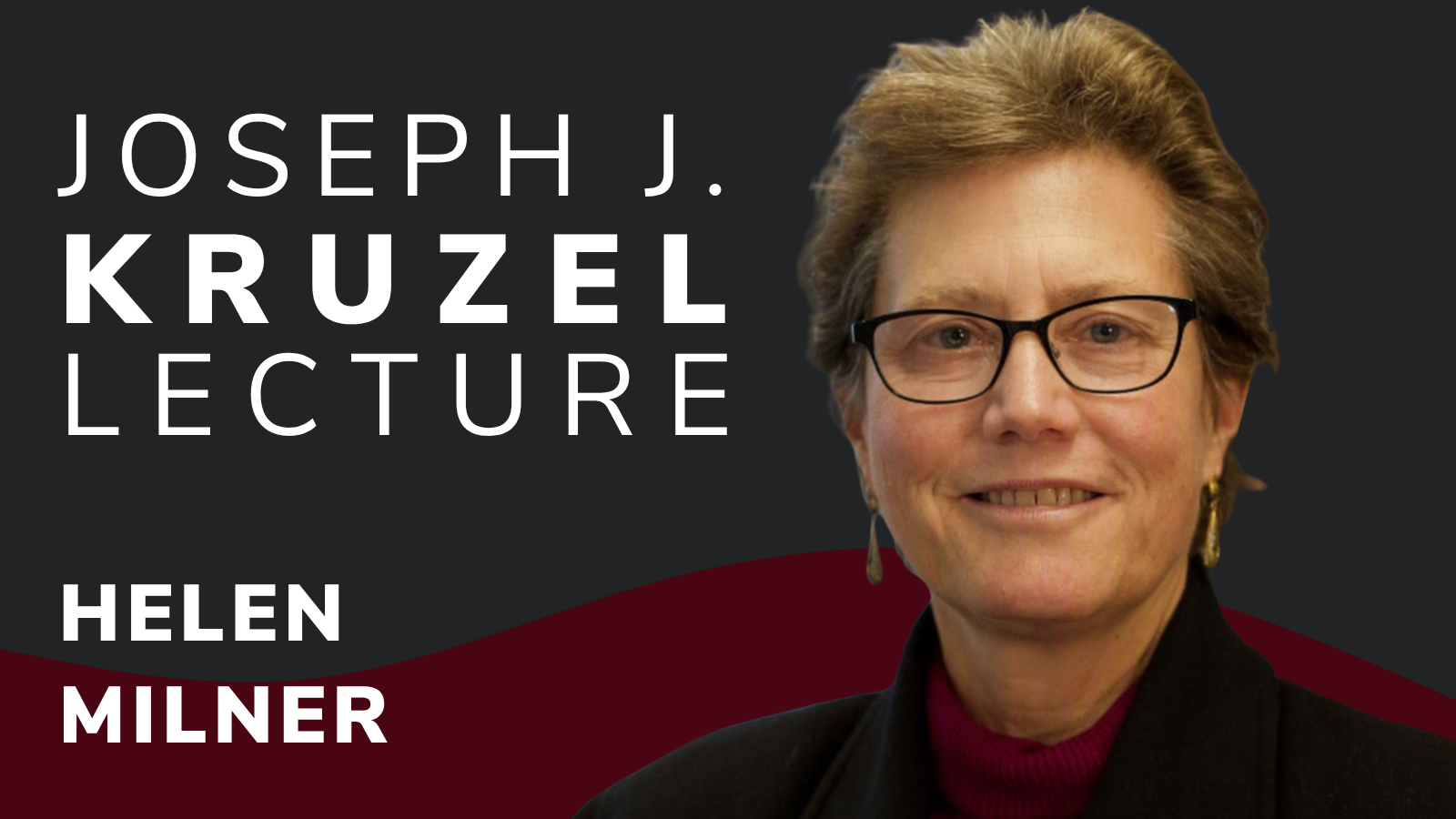
This year’s Kruzel Lecture features Helen V. Milner, who will speak on “Climate Fault Lines: The New Political Economy of a Warming World.”
Milner is the B.C. Forbes Professor of Politics and International Affairs at Princeton University and the director of the Niehaus Center for Globalization and Governance at Princeton's School of Public and International Affairs. She was the chair of the Department of Politics from 2005 to 2011. She was president of the International Studies Association (ISA) for the 2020-2021 term and was president of the International Political Science Association (IPSA) from 2012-14. She is a member of the National Academy of Sciences, the American Academy of Arts and Sciences, and the Council on Foreign Relations. She has written extensively on issues related to international and comparative political economy, the connections between domestic politics and foreign policy, and the impact of globalization on domestic politics. She works on topics related to globalization and development, such as the political economy of foreign aid, the "digital divide" and the global diffusion of the internet, the resource curse and non-tax revenues, and the relationship between globalization and democracy, in Africa and the Middle East. She was a fellow in 2021-2022 at the Center for Advanced Study in the Behavioral Sciences at Stanford University.
Some of her writings include Resisting Protectionism(1988), Interests, Institutions and Information: Domestic Politics and International Relations (Print)(1997) (ebook link), Votes, Vetoes, and the Political Economy of International Trade Agreements(2012), The Political Economy of Economic Regionalism(1997), and Internationalization and Domestic Politics(1996). Her newest book is Sailing the Water’s Edge: Domestic Politics and American Foreign Policy, coauthored with Dustin Tingley (Princeton University Press, 2015). It won the 2016 Gladys M. Kammerer Award for the best book published in the field of U.S. national policy. You can read more about the book in recent reviews published in Harvard Magazine, Perspectives on Politics, Governance, H-Diplo/H-Net Reviews, the New England Journal of Political Science, and Passport.
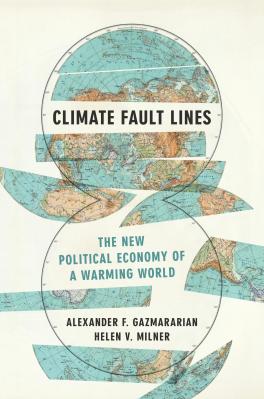
Her most recent book, co-authored by Alexander F. Gazmararian, Climate Fault Lines: The New Political Economy of a Warming World (Princeton University Press, 2026), explores how the unequal burdens of climate change are reshaping both domestic and international politics. Climate change is no longer an abstraction, as the world experiences extreme heat, rising sea levels, and brutally destructive wildfires. Climate Fault Lines shows that the effects of climate change are far from equal, with the most severe damages concentrated in the world’s hottest regions. It argues that this divide—a fault line that cuts across existing social, economic, and political divisions—will produce diverging political responses to the changing climate. People, businesses, and governments on the more vulnerable side of the fault line are highly motivated to address climate change because they directly experience its intensifying effects. Those on the other side, however, have less motivation to address the problem, and when they do enact climate policy, it’s mainly for other reasons—cleaner air, economic gains, or greater energy security.
Milner and Gazmararian support their argument—which departs from the prevailing wisdom that Northern European states are climate leaders whereas developing nations are free riders—by bringing together models from economics, geosciences and political science. The data show that voters and businesses with the most to lose are reshaping the incentives and policies of local and national governments below the fault line. Unequal harm, not shared global vulnerability, increasingly informs climate politics.
The Joseph J. Kruzel Lecture
Each year the Mershon Center for International Security Studies hosts a lecture to honor the memory of Joseph J. Kruzel Jr. (1945-1995.) Kruzel taught political science at The Ohio State University between episodes of public service that included briefing the Joint Chiefs of Staff during the Vietnam War, serving in the State Department delegation to the Strategic Arms Limitations Talks in Helsinki, and joining the Clinton Administration in 1993 to serve as Deputy Assistant Secretary of Defense for European and NATO policy.
In this role, Kruzel created Partnership for Peace, a program instituted in 1994 to build trust and cooperation between NATO and non-member states in Eastern Europe. He was sent to Bosnia as the Defense Department special envoy and chief negotiator on the US team working to end the Yugoslav Wars. In 1995, in the course of that mission, he was killed with two other US diplomats when their armored personnel carrier crashed into a ravine. President Clinton awarded him, posthumously, the Presidential Citizens Medal.