Military Effectiveness since 1945
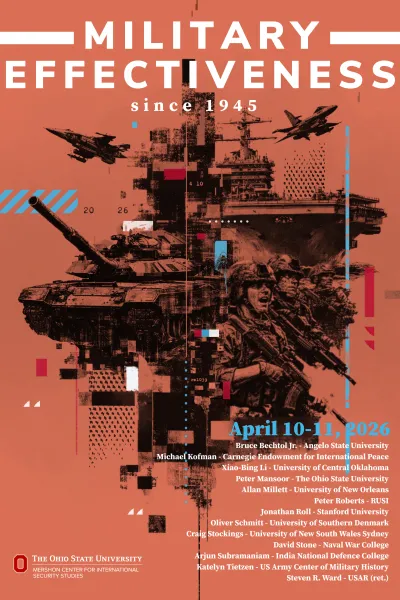
April 10-11, 2026
The effectiveness of military organizations is dependent on their ability to secure the resources required to maintain, expand, and reconstitute themselves; the ability to secure by force national goals defined by political leadership by executing plans specifying time, geography, mission, and objectives; the analysis, selection, and development of institutional concepts or doctrines for employing major forces to achieve strategic objectives by analyzing, planning, preparing, and conducting various facets of military campaigns; and the ability of combat forces to fight engagements in order to secure operational objectives, which involves the movement of forces on the battlefield against the enemy, the provision of destructive fire upon enemy forces or targets, and the arrangement of logistical support directly applicable to engagements. Military effectiveness also relies on the creation and maintenance of a supportive organizational culture to support the strategic, operational, and tactical effectiveness of armed forces.
Organized by Peter R. Mansoor, the Gen. Raymond E. Mason Jr. Chair of Military History at the Mershon Center for International Security Studies, the Military Effectiveness since 1945 conference will explore the development of effective (and ineffective) military organizations from 1945 to the present. The conference will take place Friday, April 10, 8:30am-4:30pm through Saturday, April 11, 8:30am-12:00pm at the Mershon Center for International Security Studies.
Participants include:
- Craig Stockings, University of New South Wales Sydney
- Xiao-Bing Li, University of Central Oklahoma
- Olivier Schmitt, University of Southern Denmark
- Peter Roberts, RUSI
- Arjun Subramaniam, India National Defence College
- Steven R. Ward, former CIA military analyst and LTC, USAR (ret).
- Katelyn Tietzen, US Army Center of Military History
- Jonathan Roll, Barry and Teri Volpert Family Postdoctoral Fellow at the Hoover Institution's History Lab
- Bruce Bechtol Jr., Angelo State University
- Michael Kofman, Carnegie Endowment for International Peace
- David Stone, Naval War College
- Allan Millett, University of New Orleans
- Peter Mansoor, The Ohio State University
Agenda
Friday, April 10
- 7:45-8:15 am: Coffee service and continental breakfast
- 8:15-8:30 am: Welcome, Administrative Announcements, and Introduction
- Dr. Peter R. Mansoor, General Raymond E. Mason, Jr. Chair of Military History
- 8:30-9:00 am: “Military Effectiveness,” Dr. Allan Millett, Professor Emeritus, The Ohio State University
- 9:00-10:30 am: Panel 1 – France and the United Kingdom
- France (via Zoom): Olivier Schmitt, University of Southern Denmark
- United Kingdom: Peter Roberts, The Alphen Group and senior associate fellow at RUSI
- 10:30-10:45 am: Break
- 10:45 am-12:15 pm: Panel 2 – China and North Korea
- China: Xiao-Bing Li, University of Central Oklahoma
- North Korea: Bruce Bechtol Jr., Angelo State University
- 12:15-1:00 pm: Lunch
- 1:00-2:30 pm: Panel 3 – Iraq and Iran
- Iraq: Katelyn Tietzen, US Army Center of Military History
- Iran: Steven R. Ward, former CIA military analyst and LTC, USAR (ret).
- 2:30-2:45 pm: Break
- 2:45-4:15 pm: Panel 4 – The Soviet Union and Russia
- The Soviet Union: David Stone, Naval War College
- Russia (via Zoom): Michael Kofman, Carnegie Endowment for International Peace
- 4:15-5:15 pm: Panel 5 – Australia
- Australia (via Zoom): Craig Stockings, University of New South Wales Sydney
Saturday, April 11
- 7:45-8:15 am: Coffee service and continental breakfast in Mershon Center Lobby
- 8:15-9:15 am: Panel 6 – India
- India: Arjun Subramaniam, India National Defence College
- 9:15-09:30 am: Break
- 09:30-11:00 am: Panel 7 – The United States and Israel
- Israel (via Zoom): Jonathan Roll, Postdoctoral Fellow, Hoover Institution
- The United States: Dr. Peter Mansoor, The Ohio State University
- 11:00 am-11:30 am: Conference Wrap-up and the Way Ahead
- 11:30 am: Grab and Go Lunch
This is a working conference designed to produce an edited volume that serves national security policy makers, senior military leaders, experts in military history and international relations, and others interested in how states succeed or fail in developing effective military organizations. The edited volume will also be of value in the curricula of professional military educational organizations, such as the service and national war colleges.