The Evolution of the Mershon Search Lab
Building International Collaboration on Missing and Disappeared Persons
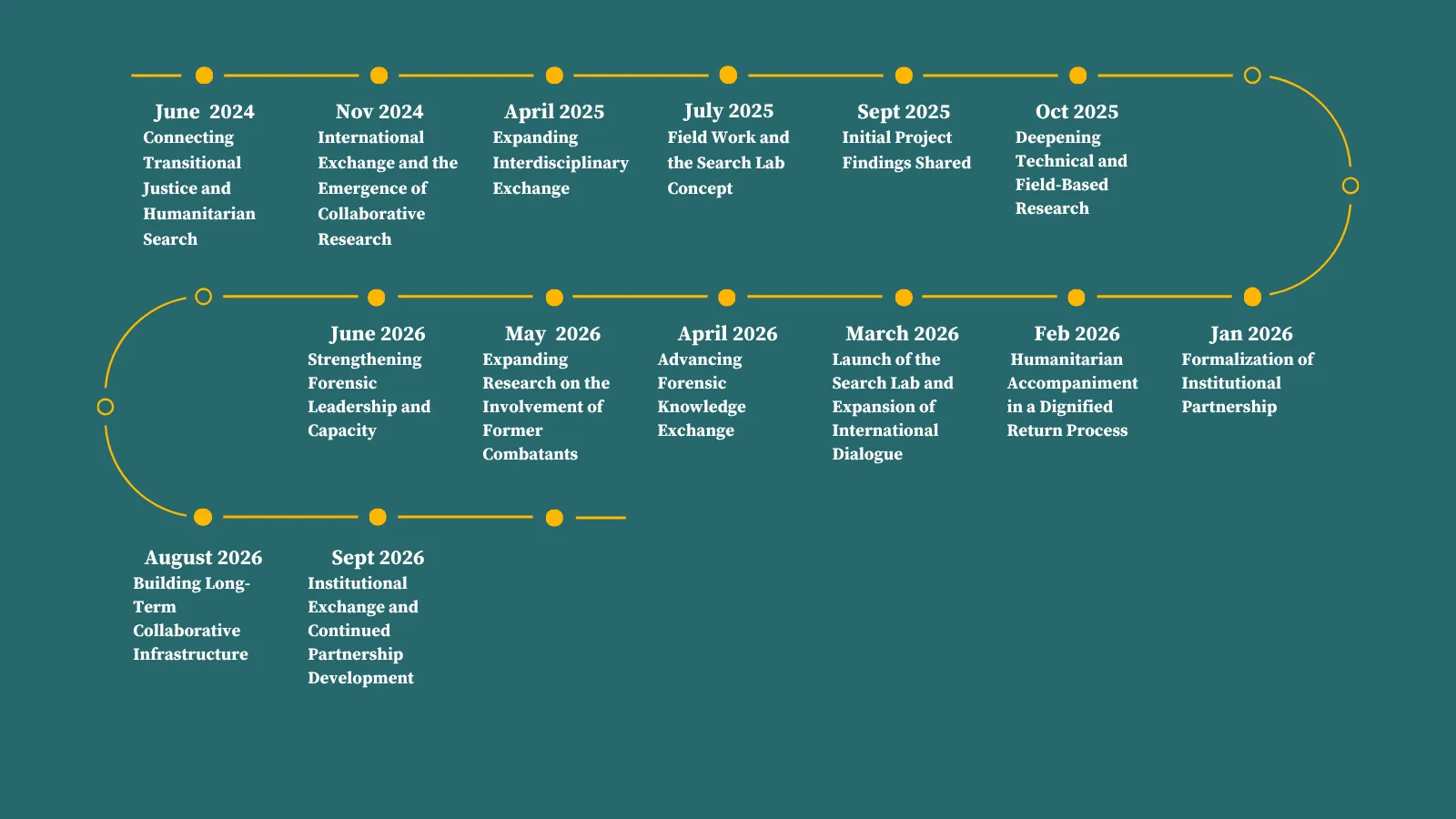
The Mershon Search Lab at The Ohio State University (Ohio State) emerged through a sustained process of international exchange between academic researchers, forensic practitioners, and humanitarian institutions working on the search for missing and disappeared persons in conflict affected settings. What began through individual relationship-building and exploratory conversations around humanitarian search, dignified return, and the social dimensions of disappearance gradually developed into a structured interdisciplinary alliance grounded in fieldwork, shared analysis, and a formal institutional agreement. The timeline below traces key milestones in the formation of the Lab and its partnership with Colombia’s Unidad de Búsqueda de Personas dadas por Desaparecidas (UBPD).
June 2024
Early Connections in Transitional Justice and Humanitarian Search
At an international gathering in Northern Ireland, hosted by the University of Notre Dame on innovative approaches to transitional justice and disappearance in Colombia and Ireland, Teri Murphy (Mershon Center for International Security Studies, "Mershon Center") met with leadership from Colombia’s UBPD, the Truth Commission, and the Special Jurisdiction for Peace (JEP). These initial conversations identified shared interests in the humanitarian dimensions of search processes, as well as the role of ritual and memory in contexts of disappearance, and opened discussion about future initiatives with The Ohio State University.
The following week at a conference entitled “The Disappeared: Addressing the Legacies and Challenges of Confronting Disappearance” at Queen’s University Belfast, engagement with Colombia deepened. UBPD Director Dr. Luz Janeth Forero connected Teri with Juan Diego Castro, Special Advisor and Head of Knowledge and Information Systems at UBPD. Discussions about building joint activities began immediately.
November 2024
International Exchange and the Emergence of Collaborative Research
An invitation from UBPD to Teri Murphy to serve as an external observer for a delegation of Syrian NGO representatives working to resolve disappearances in Syria provided early insight into the global relevance of Colombia’s humanitarian search framework. The visit highlighted how Colombia’s institutional model was becoming an important reference for other conflict contexts interested in developing systematic approaches to locating missing persons.
During that visit, Teri Murphy was also able to facilitate a workshop bringing together UBPD leadership and field investigators to share insights on the role of rituals and ceremonies in the dignified return of bodies of those who had disappeared. These discussions identified shared research questions and methodological gaps, helping shape the foundation of what would become multi-year project.
April 2025
Expanding Interdisciplinary Exchange
Leaders from the Mershon Center and faculty from Ohio State in forensic anthropology and geography met with representatives from UBPD to explore opportunities for joint project development. The involvement of additional university leadership and faculty marked an important shift from relationship-building to more structured planning across scientific and social scientific domains. Among those engaged was Nicholas Passalacqua (Anthropology), whose internationally recognized expertise helped further expand the scientific dimensions of future research.
This period also brought new connections among forensic experts working in Colombia and the United States, strengthening technical exchange around identification practices and forensic methodologies. Through Passalacqua’s longstanding professional relationship with Derek Congram - with whom he had previously worked at the U.S. Department of Defense Central Identification Laboratory - interaction developed a more focused agenda aimed at improving approaches to identification in complex humanitarian and forensic contexts.
July 2025
Field Engagement and the Conceptualization of the Search Lab
The project Ritual Landscapes: Returning the Disappeared of Colombia formally began, involving interviews with leaders from UBPD, the Special Tribunal for Peace (JEP), civil society organizations, and Colombia’s National Institute of Legal Medicine and Forensic Sciences. The project’s initial phase sought to establish a foundational understanding of how key stakeholders defined ritual in relation to protocols and institutional practices, and how they understood concepts such as dignity and dignified return within humanitarian search and identification processes.
That same month, an interdisciplinary team from Ohio State and UBPD conducted field visits in Bogotá and in regions including Caucasia, Medellín, and the Río Cauca basin. During the visit, Ohio State and UBPD researchers met to exchange methodologies, data, and analysis. They also visited active exhumation sites, forensic laboratories, and areas deeply affected by disappearance during armed conflict.
These experiences marked a turning point in discussions. Exposure to ongoing investigative work, technical challenges, and the sustained suffering of families searching for loved ones clarified the need for a more integrated and systematic approach to the evolving alliance. During this period, the concept of what would become the Search Lab first emerged.
September 2025
Initial Project Findings Shared
Preliminary findings from Ritual Landscapes: Returning the Disappeared of Colombia were presented to UBPD leadership and shared with field investigators for feedback and refinement. Phase II of the project began.
October 2025
Deepening Technical and Field-Based Research
Collaborative work expanded across forensic anthropology and environmental geography, including joint fieldwork in Colombia and laboratory-based analysis of skeletal trauma and identification methods. Parallel investigations in riverine and dam-affected landscapes, led in part by Alvaro Montenegro (Geography), initiated a new line of inquiry focused on water-based search strategies for missing persons.
At the same time, structured discussions on rituals and dignified return practices continued through advisory group meetings, bringing together researchers and practitioners to review emerging findings, identify gaps between institutional approaches and field realities, and inform the design of the next phase of the project.
January 2026
Formalization of Institutional Partnership
The Ohio State and Colombia’s UBPD established a formal alliance, creating a cross-institutional framework for joint work in research, training, forensic science, humanitarian search strategies, and knowledge exchange related to missing and disappeared persons.
This agreement marked a significant transition from informal exchanges to an institutional partnership designed to support sustained interdisciplinary and international cooperation.
February 2026
Humanitarian Accompaniment in a Dignified Return Process
Derek Congram and Teri Murphy were invited to serve as international experts in a dignified return process involving the identification of Father Camilo Restrepo, a former priest who joined the National Liberation Army (ELN) in 1965 and was killed during his first combat experience. This visit reflected the applied dimension of the alliance, including humanitarian accompaniment and practices related to dignified return protocols and recognition of the deceased.
March 2026
Launch of the Mershon Search Lab and Expansion of International Dialogue
The Mershon Search Lab at Ohio State was formally launched as an interdisciplinary initiative dedicated to research, training, and global collaboration on missing and disappeared persons in conflict and post-conflict settings. The Mershon Search Lab integrates expertise from forensic anthropology, geography, social psychology, transitional justice, and humanitarian practice to support both applied and field-informed research.
In the same period, international dialogue expanded through conversations between UBPD leadership and peace-building actors from other regions. Teri Murphy facilitated a meeting between UBPD leadership and the Lebanese non-governmental organization Fighters for Peace to explore future work related to locating and identifying missing persons in Lebanon, including discussions about the role of former combatants in humanitarian search processes.
April 2026
Advancing Forensic Knowledge Exchange
Ohio State researchers and UBPD forensic specialists participated in technical exchanges focused on skeletal analysis, trauma interpretation, and identification practices in complex forensic cases. As part of these consultations, Nick Passalacqua and Derek Congram joined the event Reading the Skeleton in Search Contexts: Experiences in the Analysis of Bone Alterations for Identification Purposes alongside UBPD personnel. The workshop focused on skeletal trauma, pathology, and postmortem damage to bone, as well as a review of active identification cases. These meetings strengthened shared technical capacity and supported on-going discussion of ongoing investigative challenges.
May 2026
Expanding Research on the Involvement of Former Combatants
A new collaborative research initiative was launched examining humanitarian and extrajudicial approaches to engaging individuals with direct or indirect experience of armed conflict in support of search and identification processes for missing persons. The project builds on the Lab’s broader interest in how knowledge of disappearance is carried forward and activated across different roles, including former combatants, witnesses, and the families who have long contributed to search efforts outside formal institutions.
June 2026
Strengthening Forensic Leadership and Capacity
Forensic anthropologist Derek Congram joined the Mershon Search Lab as Co-Director, strengthening its expertise in forensic identification, humanitarian investigations, and international field operations. His appointment reflects the Lab’s emphasis on integrating academic research with applied forensic practice.
August 2026
Building Long-Term Collaborative Infrastructure
An interdisciplinary team from Ohio State and the University of Central Florida (UCF) conduct research at the UBPD laboratory in Medellín focused on improving methods for analyzing commingled skeletal remains. Nick Passalacqua, Derek Congram, and Matthieu Baudelet (UCF) travel to Medellín to carry out work using laser-induced breakdown spectroscopy to refine approaches for identifying and separating human remains when bones from multiple individuals have been mixed together - a common challenge in contexts involving mass graves and the poor management of the dead following conflict or disasters.
In parallel, collaboration with UBPD’s Pedagogy Team develops curriculum for a shared distance-learning platform and a new course in Disappearance Studies at Ohio State, advancing the Lab’s education and training mission. During the same period, Hollie Nyseth-Nzitarita (Sociology) and Elizabeth Marsch (Distance Learning) work with UBPD’s Pedagogy Team on this initiative, contributing to the design of shared coursework and the development of the distance-learning platform.
Research on the involvement of former combatants in humanitarian search processes continues through the development of a publication on UBPD’s humanitarian contributor’s framework, regional workshops with Latin American partners, and ongoing examination of how participation in search efforts may contribute to reintegration and broader reparative processes following armed conflict.
September 2026
Institutional Exchange and Continued Partnership Development
UBPD leaders visit The Ohio State University.